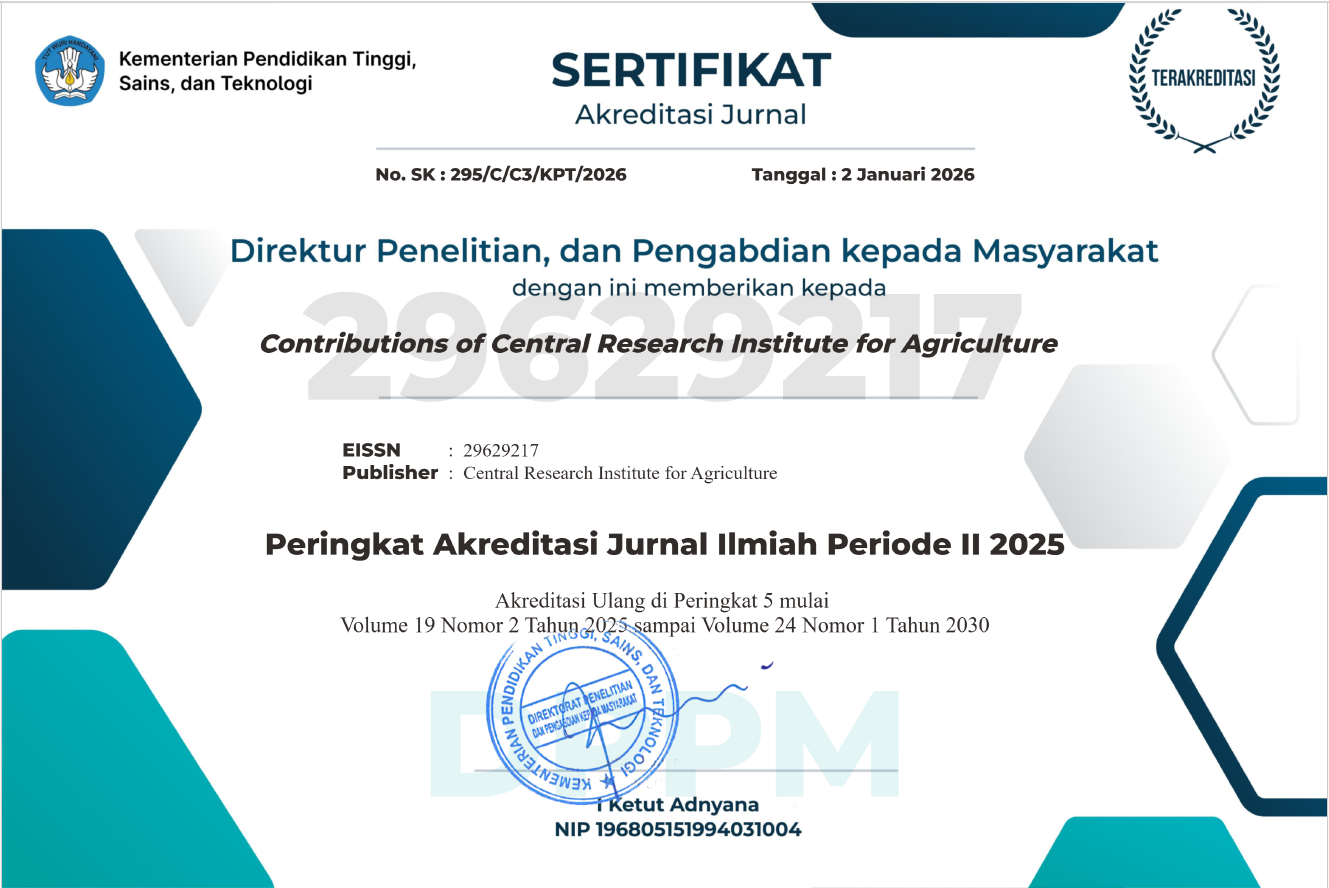
Correlation Between Quantitative Traits and Dry Land Sugarcane (Saccharum hybrid) Yield
DOI:
https://doi.org/10.59651/cceria.v15i2.34Keywords:
Quantitative Traits, Sugarcane Biomass, Dry landAbstract
This study aims to determine the relationship (correlation) between quantitative traits and biomass of sugarcane Saccharum officinarum L.). The hypothesis that can be put forward in this study is that there is a positive and negative correlation between quantitative traits and biomass yield of sugarcane Saccharum officinarum L.). Sugarcane (Saccharum officinarum L.) is a plantation commodity that is widely developed in Indonesia because Indonesia's climate is suitable for the growth of sugar cane. In Indonesia, so far the cultivation of sugar cane is mostly done in paddy fields. However, because the need for rice continues to increase, more and more paddy fields are used for rice cultivation. This causes sugarcane land in paddy fields to shrink and shift to dry land or dry land. The average sugarcane yield on dry land in Java is only 67% of that of irrigated paddy fields. Meanwhile, the productivity of dry land outside Java is only 58% of that of irrigated paddy fields in Java. The decrease in sugarcane productivity is thought to be due to the shift in sugarcane planting from wet to dry land. Yield loss due to drought (water stress) can reach 40% of its production potential if it occurs during a critical plant phase. The success of efforts to obtain plants that have good quality and quantity of yield is greatly supported by the ability of plant breeders to obtain superior genotypes in the selection stage. In carrying out selection, plant breeders are often faced with the problem of making a choice of genotypic traits that are considered superior, therefore it is necessary to know the relationship (correlation) between quantitative traits and yields in these plants.
References
Alexander, A. G. 1973. Sugarcane Physiology. Elsevier Scientific Pub. Co. Amsterdam. p. 167-171.
Anonymous. 2008. Informasi Spesies. Tebu. Available online update at http://www.plantamor.com/index.php?plant=1100 (Verified 17 April 2009). . 2009. Teori Analisis Korelasi, Mengenal Analisis Korelasi. Available online update at http://www.jonathansarwono.info/korelasi.htm (Verified 11 Mei 2010).
Anshori, S. 2002. Genetika. Edisi II. Erlangga. Jakarta. p. 30-41.
Ariffin. 2002. Cekaman Air dan Kehidupan Tanaman. Unit Penerbitan Fakultas Pertanian. Univesitas Brawijaya. pp. 96.
Aspinal, D. and L. G. Paleg. 1981. The Physiology and Biochemistry of Drought Resistance in Plants. Academic Press. Australia. p. 243-259.
Crowder, L. V. 1997. Genetika Tumbuhan. Gadjah Mada University Press. Yogyakarta. pp. 499.
Djarwanto, P. S. dan S. Pangestu. 1993. Statistik Induktif. BPFE. Yogyakarta. p. 88-92.
Doorenbos, J dan A. H. Kassam. 1981. Yield Response to Water. Food and Agriculture Organization of United Nation. Roma. p. 145-149.
Falconer, D. S. 1972. Introduction to Quantitative Genetics. The Roland Press Company. New York. pp. 312.
Falconer, D. S. and T. F. C. Mackay. 1996. Introduction to Quantitative Genetics.
Fourth Edition. Longman. Harlow. p. 312-334 Fehr, W. R. and H. H. Hadley. 1980 Hybridization of Crop Plants. The American Society of Agronomy Inc. USA. p. 617-629.
Garrity, D. P., C. Y. Sullivan., and D. G. Watts. 1984. Changes in grain sorghum stomatal and photosynthetic response to moisture stress across growth stages. Crop Sci. 24: 124-129.
Gupta, U. S. 1975. Physiological Aspect of Dryland Farming. Hargama Agricultural University. India. p. 147-162.
Hanafiah, K. A. 1994. Dasar-Dasar Agrostatistika. Raja Grafindo. Jakarta. p.55-63
Hendroko, Pertiningsih, dan Tjokrodirjo. 1987. Mengenal Tanaman Tebu.
Lara Widya Pustaka. Jakarta. pp. 62.
Hidayat, D. 2002. Tawaran Manis Tebu Transgenik. Available online update at http://www.korantempo.com/news/2002/9/19/Ilmu%20dan%20Teknologi/ 32.html (Verified 4 Maret 2008).
Indriani dan Sumiarsih. 1992. Pembudidayaan Tebu di Lahan Sawah Dan Tegalan. Penebar Swadaya. Jakarta. p. 18-46.
Irianto, G. 2003. Tebu Lahan Kering dan Kemandirian Gula Indonesia. Tabloid Sinar Tani. 20 Agustus 2007. p.1-3.
Islami, T dan W. H. Utomo. 1995. Hubungan Tanah, Air, dan Tanaman. IKIP Semarang. Press Semarang. p. 211-240.
Jumin, H. B. 1989. Ekologi Tanaman; Suatu Pendekatan Fisiologis. Rajawali Press. Jakarta. p. 11-29
Knight, R. 1976. Quantitative Genetics, Statistics and Plant Breeding in R. Knight (ed) Plant Breeding. A Wiley Interscience Publication John Wiley & Sons. New York. p. 11-13.
Kozlowski, T. T. 1976. Water Deficit and Plant Growth IV : Soil Water Measurement, Plant Response and Breeding for Drought Resistence. Academic press. New York. p. 317-345.
Kuntahartono, T. 1999. Stadium pertumbuhan batang tebu. Majalah Gula Indonesia. 14 (4): 38.
Kuswanto. 1992. Peranan korelasi antar sifat dalam meningkatkan efektifitas seleksi sawi varietas lokal. Makalah Seminar. Program Pasca Sarjana. Universitas Gajdah Mada. Yogyakarta. p. 1-14.
Lakshmikantham, M. 1989. Technology in Sugarcane Growing. Second Edition. Oxford and IBH Publishing.Co. India. p. 109-113.
Levitt, J. 1980. Responses of Plants to Environmental Stresses. Vol II Water, Radiation, Salt and other Stresses. 2nd edition. London Academic Press. UK. pp. 334.
Mangoendidjojo, W. 2003. Dasar-Dasar Pemuliaan Tanaman. Penerbit Kanisius. Jogjakarta. p. 30-34
Miller, D. E. 1986. Root systems in relation stress tolerance. Horticulture Science 21 : 963-970.
Mirzawan, P. D. N., J. F. Van Breemen., dan G Sukarso. 1988. Ketahanan varietas tebu di lahan kering. Prosiding Seminar Budidaya Tebu Lahan Kering. Pusat Penelitian Perkebunan Gula Indonesia. Pasuruan. p. 95-103.
Mongelard, J.C. and l.G. Nickell. 1971. The sugarcane plant in the soil-plant atmosphere continum. Proc. ISSCT Congress. 14th Louisiana. pp. 14.
Moore, P.H. 1987. Breeding for Stress Resistance dalam Heinz, D (ed). 1987. Sugarcane Improvement Through Breeding. Elsevier. Amsterdam. p. 503- 542.
Mubien, B. 1992. Pengaruh penekanan pemberian air terhadap laju transpirasi pada tanaman tebu. Berita P3GI. p. 145-150.
Notodjoewono, A.W. 1983. Perkebunan Tebu Lengkap. PT Bale Bandung. Bandung. pp. 106.
Nugrahaeni, N dan St. A Rahayuningsih. 1994. Profil koleksi plasma nutfah ubi jalar di BALITTAN Malang. Edisi Khusus BALITTAN Malang. p. 196- 204
Parker, J. 1968. Drought-Resistence Mechanisms. dalam Kozlowski, T.T (ad) 1968. Water Deficits and Plant Growth I : Development, Control and Measurement. Academic Press. New York : 209
Soemartono dan Nasrullah. 1988. Genetika Kuantitatif. Universitas Gajahmada Yogyakarta. p. 144-157.
Walker, D. I. T. 1965. Some correlation in sugarcane selection in Barbados. Proc. ISSCT 12 : 650-655.
Widyasari, B. W. dan E. Sugiyarta. 1997. Akumulasi prolin dalam jaringan daun tebu sebagai indikator sifat varietas tebu tahan kering. Majalah Gula Indonesia. Pasuruan. 33 (1) : 1-10.
Zen, S. 1995. Korelasi genotipik dan fenotipik karakter padi gogo. Zuriat Vol. 6 (1): 25-32.