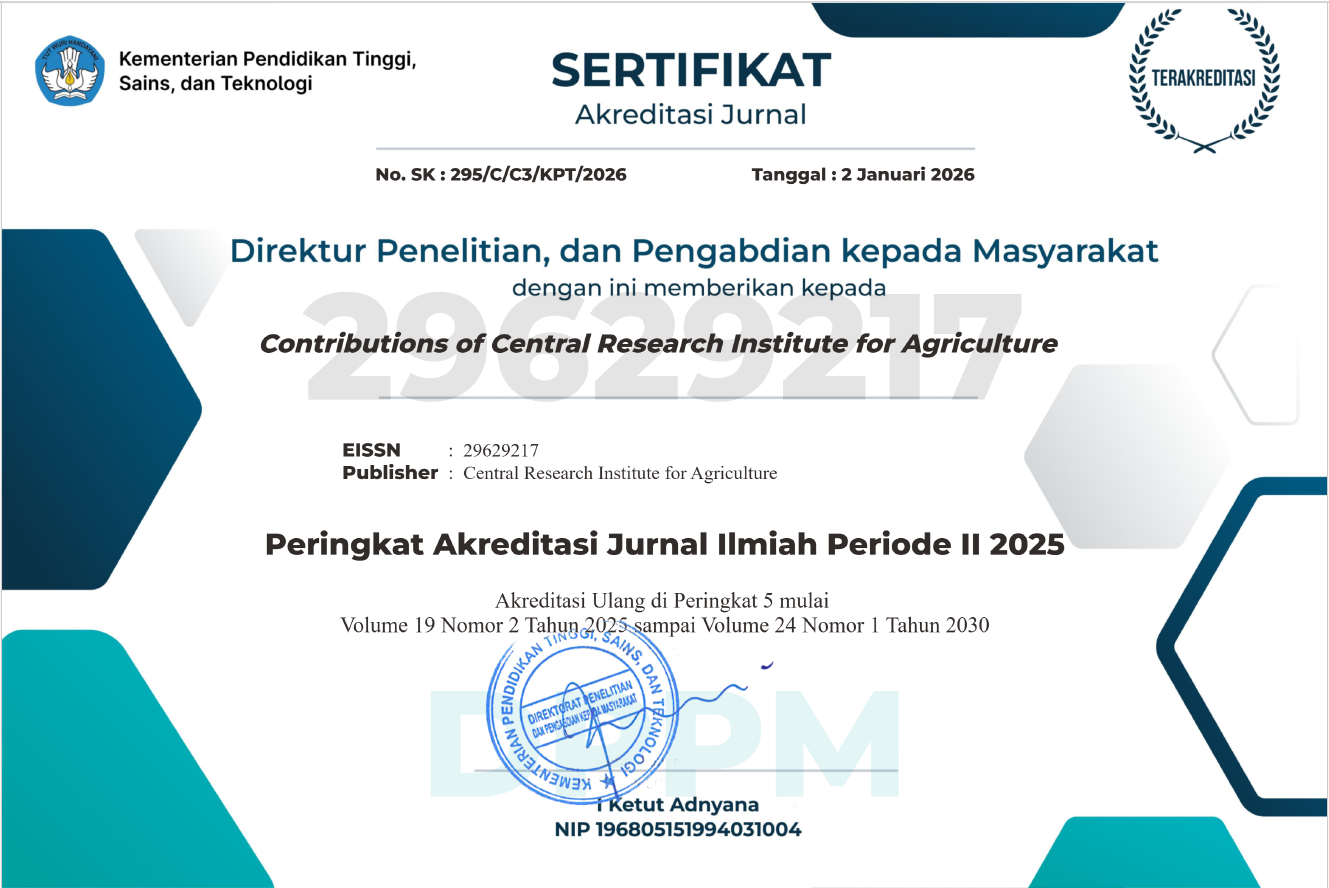
A nutrient analysis of various taro varieties in the Sangihe Islands region
DOI:
https://doi.org/10.59651/cceria.v18i1.123Keywords:
Food Processing, Nutritional Composition, Taro VarietiesAbstract
The Sangihe-Talaud region hosts several taro varieties whose nutritional composition in raw, steamed, and fried states remain unknown. This study examined these varieties, their processing methods, and their impact on taro's nutritional components, encompassing energy, protein, fat, carbohydrates, dietary fiber, ash, calcium, phosphorus, iron, vitamin C, moisture content, and sensory preferences. The investigation encompassed Macape Marramu, Macape Darrana, and Allae Mawira taro types subjected to raw, steamed, and fried treatments. In this study, the researchers employed a complete randomized design with two factors and four replications. The findings revealed diverse effects of treatments and their interactions on taro's nutritional profile. Treatment A₁B₂yielded the highest energy content at 116.6. The maximum protein content was observed in treatment A₂B₂. Treatment A₃B₂exhibited the highest fat content at 6.87, whereas A₁B₁, while not significantly different from A₂B₁You₃B₁, showed lower fat content. Treatment A₂B₂registered the highest carbohydrate content at 89.27. Treatment A₁B₂produced in the highest dietary fiber at 4.28. The lowest ash content was in treatment A₁B₁, while the highest was observed in treatment A₃B₂at 1.07. Treatment A₃B₂recorded the highest calcium at 125%. The maximum phosphorus content was noted in treatment A₃B₂, whereas the minimum was in A₂B₀. Treatment A₃B₂exhibited the highest iron content. The richest vitamin C content emerged in treatment A₂B₂at 15.79. The lowest moisture content was observed in treatment A₁B₂, which was not significantly different from A₂B₂(Macape Darrana; fried). Meanwhile, the highest moisture content was observed in treatment A₂B₀.
References
cottonii) IN BALERUT (SEAWED CATFISH MEATBALLS) IN TERMS OF SERVING SIZE, PROTEIN AND FOOD FIBER CONTENT. Yogyakarta Ministry of Health Polytechnic.
Aremu, C., Ojuederie, O., Olayanju, A., Modupe, A., Kayode, O., Erere, A., Faith, O., & Adebayo, S. (2021). Agricultural Productivity: A Key Component of Inclusive Growth Towards Food Security. Food Security and Safety: African Perspectives, 195–216.
Giri, N.A., Ambedkar, B., & Sakhale, B.K. (2019). Sweet potato (Ipomoea batatas L.): A valuable tropical tuber crop: A review. The Pharmaceutical Innovation Journal, 8(6), 182–191.
Junaidi, A., Mashar, A., Basrowi, B., Muharomah, D., Situmorang, J., Lukas, A., Asgar, A., Herlina, L., Manalu, L., & Payung, L. (2024). Enhancing sustainable soybean production in Indonesia: evaluating the environmental and economic benefits of MIGO technology for integrated supply chain sustainability. Uncertain Supply Chain Management, 12(1), 221–234.
Lantemona, H., & Boka, R.Y. (2023). A Nutrient Analysis Of Various Taro Varieties in The Sangihe Islands Region. Journal of Food Technology and Agricultural Sciences, 1(4), 222–235.
Melani, A., Herawati, N., & Kurniawan, AF (2022). Taro Tuber Starch Bioplastic Through the Melt Intercalation Process. Journal of Distillation, 2(2), 53–67.
Nagar, C.K., Dash, S.K., Rayaguru, K., Pal, U.S., & Nedunchezhiyan, M. (2021). Isolation, characterization, modification and uses of taro starch: A review. International Journal of Biological Macromolecules, 192, 574–589.
Olivia, S., Gibson, J., & Nasrudin, R. an. (2020). Indonesia in the Time of Covid-19. Bulletin of Indonesian Economic Studies, 56(2), 143–174.
PRAMESSHELLY, N. (2019). MANUFACTURING GLUCOSE SYRUP FROM RED DRAGON FRUIT (Hylocereus polyrhizus) BY HYDROLYSIS METHOD USING CITRIC ACID CATALYST. Sriwijaya State Polytechnic.
Sakhale, B. K., & Giri, N. A. (2019). Nutritional Values and Processing of Tropical Tuber Crops. In Technologies for Value Addition in Food Products and Processes (pp. 191–232). CRC Press.
Savin-Baden, M., & Major, C. (2023). Qualitative research: The essential guide to theory and practice. Routledge.
Solihah, I., & Wijaya, DP (2020). TUBER STARCH AND STARCH RESISTANT AS PREBIOTICS FOR HEALTH. NEM Publishers.
Sparrow, R., Dartanto, T., & Hartwig, R. (2020). Indonesia under the new normal: Challenges and the way ahead. Bulletin of Indonesian Economic Studies, 56(3), 269–299.
Tarigan, IL (2021). Basics of Water, Food and Drink Chemistry. Media Nusa Creative (MNC Publishing).
Tuarita, N.I. (2017). ANALYSIS OF PEROXIDE NUMBERS IN WOSTING OIL USING PANDAN LEAF POWDER (Pandanus Ammaryllifolius) WITH VARIATIONS IN CONCENTRATION. Muhammadiyah University of Semarang.