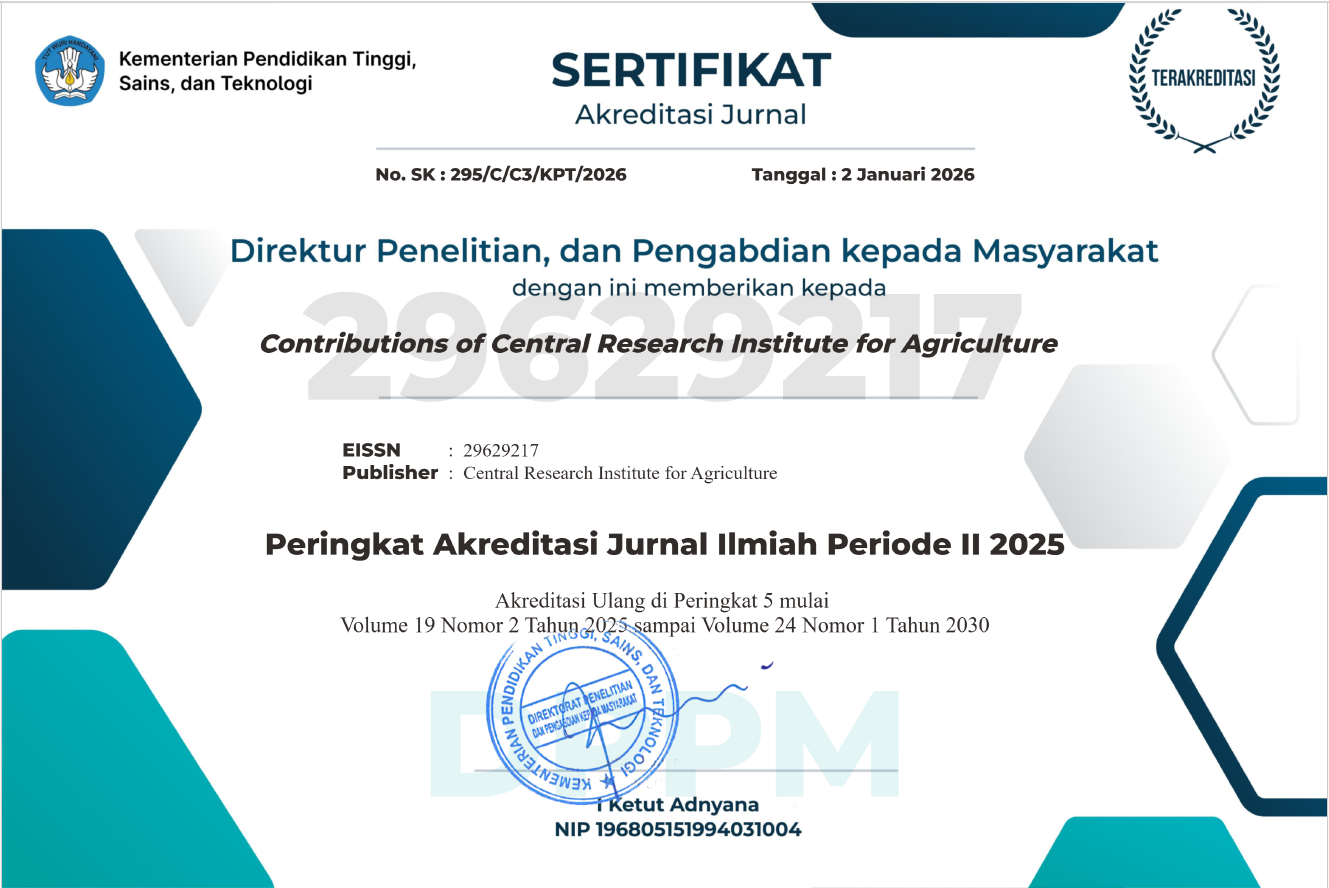
Effect of bokashi dose and frequency of administration of Plant Growth Promoting Rhizobacteria (PGPR) against pest and disease attacks on Pakcoy (Brassica rapa L.)
DOI:
https://doi.org/10.59651/cceria.v18i1.119Keywords:
Bokashi, Plant Grownt Promoting Rhizobacteria, Pakcoy, Pests, DiseasesAbstract
Pakcoy is a horticultural plant that has nutritional content tall one. so it is in great demand by the Indonesian people, but production is decreasing. This decline was caused by several reasons factors include soil fertility, pests and diseases which reduce its quality and quantity. This research aims to determine the dose of bokashi and the frequency of PGPR spraying on the growth and yield of pakcoy plants as well as reducing the intensity of pest attacks and diseases of pakcoy plants. This research was carried out on the grounds of the Faculty of Agriculture in July – September 2022. The design used is Design Random Group (RAK) fac tory Which consists of 2 factors with each factor consists of 4 levels, namely: the first-factor b okashi (T) which consists of 4 levels, namely: T0 = control/without bokashi, T1= 1:05 kg/ polybag, T2 = 1:1 kg/ polybag, T3 = 1:1, 5 kg / polybag. while the second factor is the frequency of PGPR spraying (F) which consists of 4 levels, namely F0 = control/no PGPR spraying, F1 = 2x PGPR spraying, F2 3x PGPR spraying, and F3 4x PGPR spraying so there are 16 treatment combinations available. repeated 3 times for a total of 48 experimental units. The parameters observed include plant height, number of leaves, fresh weight of plants, economic weight of plants, intensity of pest attacks, and incidence of plant diseases. All observational data were analyzed using the Duncan Multiple Range Test (DMRT) with significant 5%. The results of the research show that the dose of box h i 1: 1.5 kg/polybag and the frequency of PGPR spraying 4 times can increase plant height, number of leaves, and plant fresh weight whereas in the treatment, 2 spraying of PGPR with bokashi 1:1 kg/polybag reduced pest intensity by 9.12% and disease incidence by 7.20%.
References
A’yun, K.Q., T. Hadiastono, and M. Martosudiro. 2013. Pengaruh Penggunaan PGPR (Plant Growth Promoting Rhizobacteria), Pertumbuhan, dan Produksi pada Tanaman Cabai Rawit (Capsicum frutescens L.). http://mitalom.com/pengertiandanfungsi pgprplantgrowthpromotingrhizobacteria
Anjardita IMD, I Gusti Ngurah Raka, Ida Ayu Mayun, I Nyomann Sutedja. 2018. Pengaruh Plant Growth Promoting Rhizobakteria ( PGPR ) terhadap Pertumbuhan dan Hasil Tanaman Kacang Tanah ( Arachis hypogaea L .). 7(3), 447–456.
Anshori, B.A., M. Ihsan, L.Widiastuti. 2022. Pengaruh PGPR dan pupuk kandang terhadap pertumbuhan dan hasil tanaman paprika (Capsicum annuum L.) di dataran rendah. J. Daun. 9(1): 01-11.
Badan Pusat Statistik, 2021. Timor Tengah Utara Dalam Anngka. Kabupaten Timor Tengah Utara, Kefamennanu.
Choudhary, R. K.; Ajmal Ali, M.; Lee, J. Studies on genetic diversity amongpopulations of Persicaria barbata (L.) H. Hara from India based on internaltranscribed spacer sequences of nuclear ribosomal DNA. Saudi J. Biol. Sci.2011, 18 (2), 123–127
Gusti, I.N., Khalimi, K.,. Dewa, I.N. Ketut., & Dani, S. (2012). Aplikasi Rhizobacteri Pantoea agglomerans untuk Meningkatkan Pertumbuhan dan Hasil Tanaman Jagung. (Zea mays.L) Varietas hibrida BISI-2.Agrotrop. 2 (1):1-9.
Gupta G, Shailendra Singh Parihar, Narendra Kumar Ahirwar, Sunil Kumar Snehi and Vinod Singh. 2015. Plant Growth Promoting Rhizobacteria (PGPR): Current and Future Prospects for Development of Sustainable Agricultura. J Microb Biochem Technol 2015, 7:2 http://dx.doi.org/10.4172/1948-5948.1000188
Gomez, A.K. dan A.A Gomez. 2010. Prosedur Statistika untuk Penelitian Pertanian Edisi Kedua. Penerjemah : Endang sjamsuddin dan Justika S. Baharsjah. Universitas Indonesia Press. Jakarta
Istarofah, Z. Salamah. 2017. Pertumbuhan tanaman sawi hijau (Brassicae juncea L.) dengan pemberian kompos berbahan dasar daun paitan (Thitonia diversifolia). J. Biosite. 3(1):39-46.
Jiao, X., Takishita, Y., Zhou, G., & Smith, D. L. (2021). Plant Associated Rhizobacteria for Biocontrol and Plant Growth Enhancement. Frontiers in Plant Science, 12, 634796. https://doi.org/10.3389/fpls.2021.634796.
Kusuma, M. E. 2013. Pengaruh Pemberian Bokashi Terhadap Pertumbuhan Vegetatif Dan Produksi Rumput Gajah (Pennisetum purpureum). 2(2), 40–45.
Mafia.R., Alfenas. A., Ferreira. E., Binoti. D.,Mafia. G., & Mounteer. A.(2009). Root Colonization and Interaction Among Growth Promoting Rhizobacteria Isolates and Eucalypts Species. 33(1) :1-9
Marlita dkk. 2022. Pengaruh Dosis Pupuk Bokashi Gulma Air (Pestia sratiotes) dan Waktu Pemberian Terhadap Hasil Tnaman Pakcoy (Brasscia rapa L.). 6, No 1.
Nandal, M., & Hooda, R. (2013). Plant Growth Promoting Rhizobacteria: a Review Article. International Journal of Current Research, 5(12), 3863–3871. http://www.journalcra.com
Nik, N. 2023. Konsentrasi dan Frekuensi Aplikasi Plant Growth Promoting Rhyzobacteria (PGPR) Terhadap Serangan Hama Pada Tanaman Paria (Momordica charantia L.). Fruitset Sains: Jurnal Pertanian Agroteknologi. https://iocscience.org/ejournal/index.php/Fruitset/article/view/4607.
Oktafia, T.J., M.D. Maghfoer. 2018. Respon pertumbuhan dan hasil tanaman pakcoy (Brassica rapa L.) terhadap aplikasi EM4 dan PGPR. J. Produksi Tanam. 6(8):1974– 1981.
Sahputra 2013. Pupuk Bokashi Jerami Aplikasi dan Manfaatnya . Jakarta, Agromedia Pustaka.
Siahaan S.A .A. Siregar R. Siahaan M. 2023. Respon Ppertumbuhan Dan Produksi Bawang Putih (Allium sativum L.) Terhadap Pemberian Jerami Padi I Dan PGPR Media Tanamn Agronita . (2) 1..
Tanaka, H., Kyaw, K. M., Toyota, K., & Motobayashi, T. 2006. Influence of applicationof rice straw, farmyard manure, and municipal biowastes on nitrogen fixation, soil microbial biomass N,and mineral N in a model paddy microcosm. Biology and Fertility of Soils, 42(6).
Takishita, Y., Smith, D. L., & Smith, D. L. 2021. Plant Associated Rhizobacteria for Biocontrol and Plant Growth Enhancement. March. https://doi.org/10.3389/fpls.2021.634796
Zhou, D., Huang, X. F., Chaparro, J. M., Badri, D. V., Manter, D. K., Vivanco, J. M., & Guo, J. (2016). Root and bacterial secretions regulate the interaction between plants and PGPR leading to distinct plant growth promotion effects. Plant and Soil, 401(1–2), 259–272. https://doi.org/10.1007/s11104-015-2743-7
Zupriadi, R. Chaniago, N., & Ningsih, S.S. 2018. Effect of Organik Granules Cow Manure Fertilizer and Organik Liqud Fertilizer Application Agains Growth and Yield f Pakcoy (Brassica rapa L.). Bernas: Jurnal Penelitian Pertanian, 14 (1).